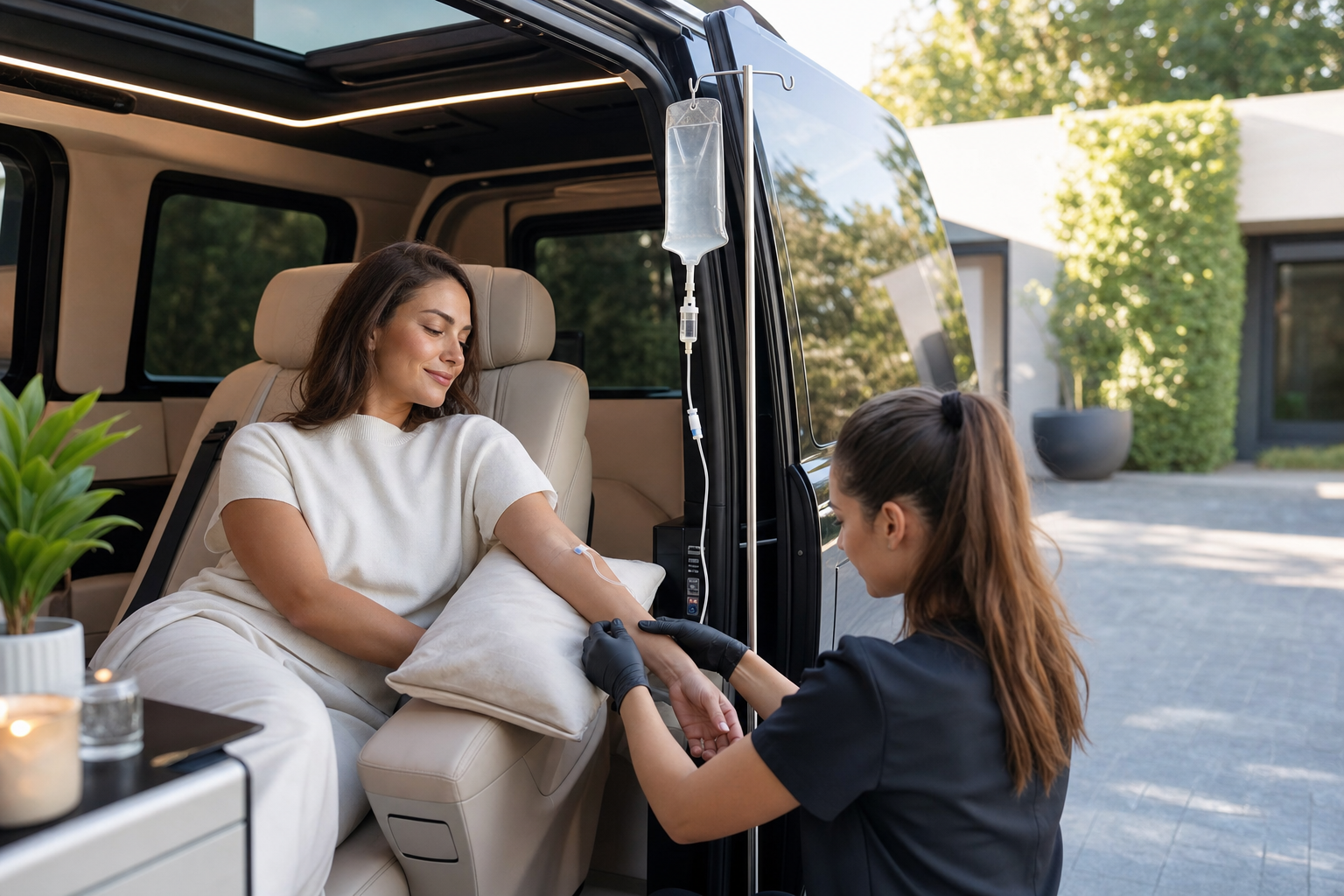

Confirm the service area
Mobile IV searches are usually convenience-driven. Patients should confirm whether their address is covered, what appointment times are available, and whether any travel or setup requirements apply.
Service area questions should be answered before a patient starts thinking about formulations. Mobile IV depends on address, timing, staff route, parking, building access, and whether the setting is appropriate for a seated appointment.
Most mobile IV patients are not asking whether mobile IV exists. They are asking if it can happen at their location, how soon it can happen, what setup is needed, and whether the service is appropriate for their situation.
Share the reason for booking
Hydration, recovery, glow, and wellness goals can point to different drip conversations. The booking message should include the reason for the inquiry rather than only asking for the earliest slot.
A booking request that only asks for the earliest slot is incomplete. The team also needs to know whether the patient is asking about hydration, recovery, glow support, post-travel convenience, or general wellness because those goals lead to different intake questions.
That is why patients need a complete checklist. Location, goal, preferred time, building access, first-time status, and health context are all practical details that help SkinDrip avoid a long back-and-forth.
Ask what happens before treatment
Patients should know what screening, consent, setup, and aftercare instructions are involved before choosing a home-service appointment.
Home service still needs the same seriousness as clinic care. Patients should expect screening, consent, a clean setup, and clear aftercare rather than treating the appointment like a casual add-on.
A home-service guide also has to set expectations about professionalism. Mobile care should still feel like clinic care in terms of screening, consent, cleanliness, monitoring, and aftercare instructions.
Mobile convenience still needs clinical structure
The home-service format is convenient, but patients should still expect screening, clear setup requirements, and staff guidance. A mobile appointment should not feel informal just because it happens outside the clinic.
Convenience is the benefit, but it should not erase clinical judgment. If the patient is new, anxious, symptomatic, or medically complex, it is reasonable to ask whether starting in the clinic would be more appropriate.
This helps avoid positioning VANity as just convenience on wheels. The page can emphasize convenience while still making it clear that the patient has to be a good fit for mobile service.
Confirm the location details early
Address accuracy, parking, building access, elevator access, and a clean seated setup can affect whether a mobile IV appointment runs smoothly. These details are worth confirming before the appointment day.
Location details can decide whether the appointment is smooth. A clear address, contact number, parking instructions, elevator access, seating area, and preferred time window help the team confirm whether VANity can be scheduled practically.
The best mobile content answers small logistical questions because those are the friction points that stop bookings. Parking, elevator access, seated space, contact number, and appointment window can all matter.
Know when clinic care may be better
A patient with unclear symptoms, complicated health history, or first-time anxiety may benefit from asking whether an in-clinic appointment is more appropriate.
WhatsApp is useful because mobile care has real logistics. A concise message with goal, location, first-time status, preferred time, and health context gives SkinDrip a better chance of responding with a specific next step.
WhatsApp coordination should be treated as part of the service experience. The easier the inquiry is to understand, the easier it is for the clinic to confirm whether mobile IV is possible that day.
Use WhatsApp for practical coordination
Mobile IV inquiries often involve timing and coverage questions. A concise WhatsApp message with location, goal, preferred time, and relevant context gives the team a clearer starting point.
Aftercare should be understood before the team leaves. Patients should know whom to message, what normal activity guidance applies, and what symptoms or reactions would require follow-up.
Aftercare content is also useful because patients may be at home without immediate front-desk context. They should know what is normal, what is not, and how to reach the clinic with questions.
Plan aftercare before the staff leaves
Before the appointment ends, patients should know what to watch for, whom to message with questions, and whether normal activities, food, fluids, or exercise need adjustment.
Mobile IV should be described as its own service path, not just the same clinic visit with a different address. Patients are usually asking about coverage, setup, timing, and suitability questions directly.
The final section should reinforce that mobile IV is not just a location swap. It is a distinct appointment path for patients whose main concern is convenience, coverage, and suitability outside the clinic.